
Across West Africa’s expanding cashew processing sector, from the Tiebissou plant in Côte d’Ivoire to growing facilities in Ghana and Nigeria, the cashew nut shelling machine is the equipment that most directly determines a processor’s margins. A machine that protects kernel integrity while delivering consistent throughput transforms raw nuts into export-ready product. One that does not will erode profits daily through breakage, downtime, and lost whole-kernel premiums.
Dekel Agri-Vision Plc, the London-listed agricultural company operating a cashew processing plant in Côte d’Ivoire, reported in its Q1 2026 production update that RCN processing volumes increased 38.5% year-on-year whilst whole-to-broken nut ratios continued to improve. Their experience illustrates a central truth: the right shelling machine, correctly configured, turns volume growth into profit growth.
Here are five dimensions to evaluate when learning how to choose a cashew nut shelling machine for your operation.
1. Throughput Capacity: Match Your Real Volumes, Not Your Ambitions
The most direct question processors ask is: how many kilogrammes per hour can it process?
The better question is: what does my daily RCN intake actually demand?
A shelling machine rated at 200 kg/h running a standard eight-hour shift can process approximately 1,600 kg per day—but only if feeding, grading, and downstream handling keep pace. Many African processors find that matching the shelling line to roughly 80% of peak daily volume provides the optimal balance between consistent utilisation and surge capacity during harvest peaks.
Dekel’s Q1 2026 figures offer a practical reference point: the company processed 1,217 tonnes of RCN during the quarter, demonstrating the volumes that a properly scaled shelling operation can handle. For context:
- Below 200 kg/day: A manual or semi-automatic shelling machine is typically the sensible choice
- 200–2,000 kg/day: Semi-automatic or entry-level automatic machines provide the right capacity range
- Above 2,000 kg/day: Fully automatic shelling systems, often configured as a multi-machine group with integrated feeding and screening, become a necessity
2. Whole Kernel Rate: The Metric That Pays Your Bills
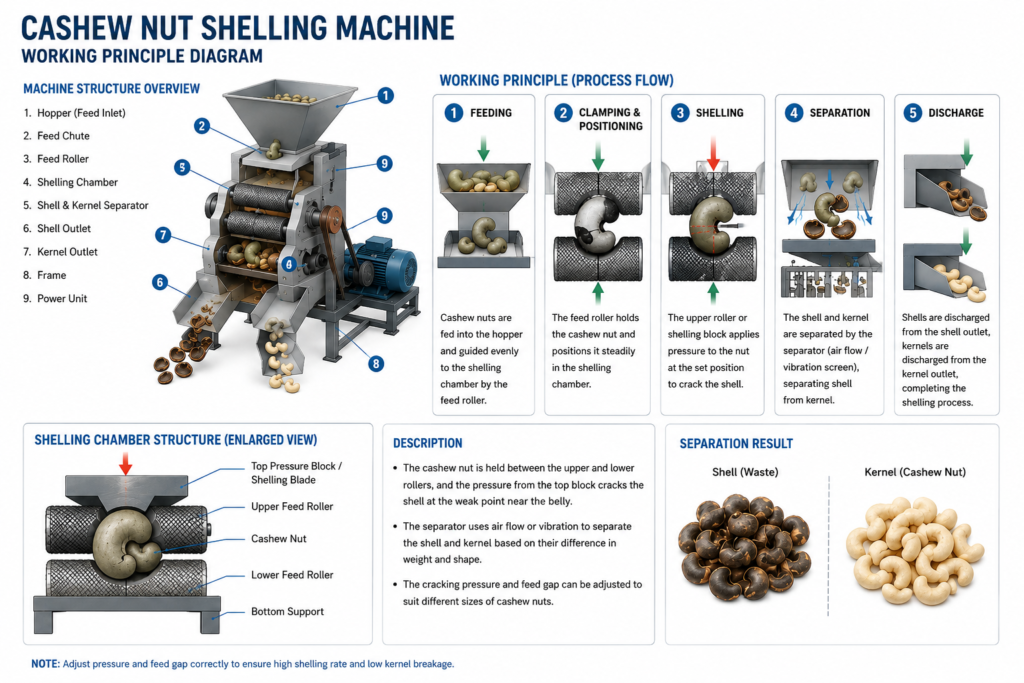
In the cashew trade, whole kernels—W240, W320, W450—command a significant price premium over broken pieces. The whole kernel rate, meaning the percentage of unbroken kernels after shelling, is therefore the most financially important specification of any shelling machine.
A well-designed machine should deliver a whole kernel rate exceeding 85%, with modern automatic systems routinely achieving above 90%. This is not magic. It results from the cashew shelling machine mechanism: the blade alignment, the depth control of the cut, and the consistency of the feeding mechanism.
The working principle is straightforward. After grading, cashew nuts are fed into the shelling machine. The nuts fall into individual positions on a rotating chain, which carries them precisely to the cutting blade. The blade strikes the shell at a calibrated depth, cracking it open without damaging the kernel inside. This design—simulating the action of manual shelling but with mechanical precision—is what protects kernel integrity at scale.
According to technical specifications from cashew processing equipment manufacturers, a properly calibrated automatic shelling machine should achieve a shell opening rate of 90–95%, with an unopened rate of approximately 3% and a breakage rate below 5–10%. The difference between 5% breakage and 10% breakage across a processing season represents a substantial financial gap.
Dekel’s Q1 2026 report highlighted that the company “continues to see improvements in whole-to-broken nut ratios”—confirming that equipment choice and calibration directly influence the kernel quality that determines market returns.
3. Grading Before Shelling: The Step You Cannot Skip
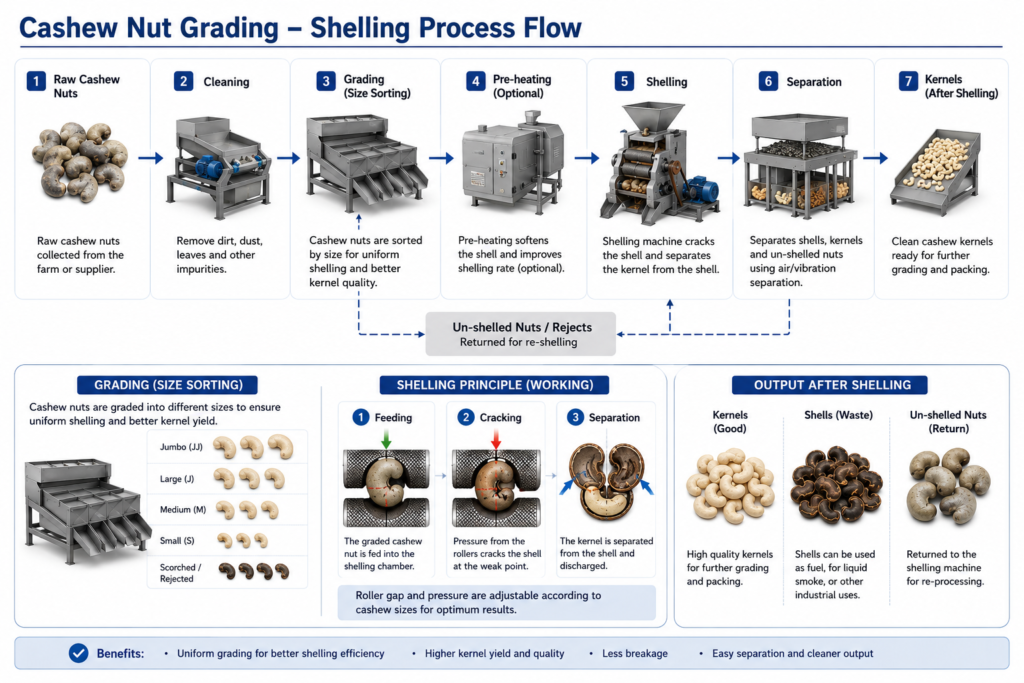
A principle that experienced processors learn quickly: the shelling machine is only as good as the grading that precedes it.
Raw cashew nuts vary in size. Feeding ungraded nuts into a shelling machine means the cutting blade cannot be calibrated to a consistent nut dimension, increasing both breakage and unopened rates. Industry standards recommend grading RCN into size bands—commonly 18 mm, 20 mm, 22 mm, 24 mm, and 26 mm—before shelling.
When nuts are graded first, the blade depth can be set precisely for each size band. The result is a higher shelling rate, fewer broken kernels, and a higher proportion of whole nuts at the end of the line. This is not optional equipment: it is process discipline that directly improves financial returns.
4. Automation Level: Align It with Your Labour Reality
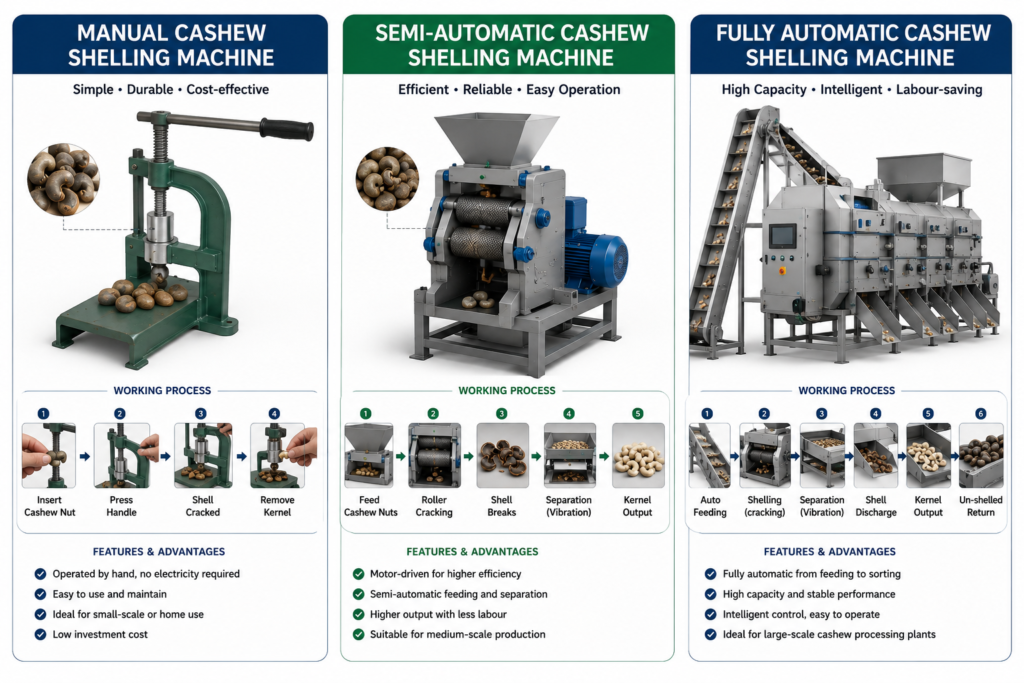
The choice between manual, semi-automatic, and fully automatic shelling is ultimately a question of labour economics.
Manual shelling machines use a foot-operated mechanism to drive the blade. The operator places each nut individually against the blade. Output is 25–60 kg per hour depending on operator skill. These machines remain viable for micro-enterprises, but labour cost per kilogramme is the highest in this category.
Semi-automatic machines mechanise the cutting action whilst the operator places the nuts. Multiple nuts can be positioned at once, pushing output to 80–120 kg per hour. These suit small-to-medium processors seeking a balance between capital cost and throughput.
Fully automatic systems use a rotating chain to carry graded nuts to the blade automatically. A single operator can oversee multiple lanes. Larger configurations—combining a conveyor hoist, a distributor, several shelling machines, and a vibrating screen for shell-and-kernel separation—can process several tonnes per day. These systems are standard for plants exceeding 2,000 kg daily, where labour cost per kilogramme drops sharply but maintenance requires trained technical staff.
For growing African plants, a phased approach serves well: begin with semi-automatic equipment and transition to full automation when daily volumes consistently justify the investment.
5. Maintenance and After-Sales Support: The Deciding Factor
In many African processing regions, the nearest qualified technician may be hundreds of kilometres away. The shelling machine that generates the best long-term return is therefore the one that continues running throughout the season.
When evaluating a machine, processors should ask the supplier:
- Are consumable parts—blades, belts, bearings—available locally or via express freight?
- What is the recommended maintenance interval during peak season?
- Can on-site staff be trained to perform blade replacement and basic troubleshooting?
- Is remote technical support available via video call?
Plant owners across Ghana and Côte d’Ivoire consistently report that the availability of local or regional service support influences equipment decisions as much as the machine specifications themselves. A machine built with readily available standard components—stainless steel for food contact parts, carbon steel for the frame—reduces long-term maintenance complexity.
FAQ
Q: What is the most important factor when choosing a cashew shelling machine?
A: Whole kernel rate and throughput capacity are typically the two metrics with the greatest financial impact. A machine must first protect kernel integrity—because whole kernels command premium prices—then deliver the required volume.
Q: How does the shelling mechanism affect kernel quality?
A: The mechanism carries graded nuts to a rotating blade that cuts the shell at a calibrated depth. Precision in blade alignment and depth control determines whether the shell is cracked cleanly or the kernel is damaged. Machines with adjustable settings for different nut sizes produce fewer broken kernels.
Q: Why is grading important before shelling?
A: Ungraded nuts have inconsistent sizes, making it impossible to set a single blade depth that works for all. Grading into size bands allows the blade to be calibrated precisely for each batch, improving shelling rate and whole kernel recovery.
Q: Should a start-up buy manual or automatic equipment?
A: For daily volumes below 200 kg, a manual or semi-automatic machine is appropriate. For volumes between 200 and 2,000 kg, a semi-automatic or entry-level automatic machine offers the best balance. The decision should be based on projected RCN intake and labour availability, not upfront price alone.
Summary: Key Factors for Choosing a Cashew Shelling Machine
| Factor | What to Look For | Why It Matters |
|---|---|---|
| Throughput Capacity | Match to ~80% of peak daily RCN volume | Prevents bottlenecks and idle capacity |
| Whole Kernel Rate | Target 85%+ for modern equipment | Whole kernels sell at premium—this drives revenue |
| Grading Before Shelling | Grade into size bands (18–26 mm) | Allows precise blade calibration; reduces breakage |
| Automation Level | Match to labour cost and technical capacity | Balances capital outlay with ongoing operating cost |
| Maintenance Support | Local parts availability; remote technical support | Keeps the line running during peak season |
Selecting a cashew nut shelling machine is a decision with consequences that echo through every processing season. As Dekel Agri-Vision’s Q1 2026 results demonstrate, the combination of increased processing volumes and improving whole-kernel ratios translates directly into stronger operational performance. A machine chosen on upfront price alone often proves the most expensive option. A machine chosen on whole kernel rate, throughput fit, grading discipline, automation alignment, and support infrastructure is the one that delivers lasting returns.