
In a cashew processing plant, every single nut that passes through the cashew nut sheller represents potential revenue—or potential waste. Crack the shell cleanly, and you have a whole kernel worth top market prices. Shatter it, and that same nut drops into the broken pile, worth a fraction of its possible value. This is why the shelling rate—the percentage of nuts successfully opened without kernel damage—is one of the most closely watched metrics on any processing floor.
A modern cashew nut sheller achieving a shelling rate of up to 96% is not just an engineering specification. It is a figure that, across thousands of tonnes of raw cashew nuts, translates directly into higher whole kernel output, stronger export pricing, and a processing operation that pays its way.
What Is a Cashew Nut Sheller?
A cashew nut sheller is the machine responsible for removing the hard outer shell of the raw cashew nut to release the kernel inside. Unlike the soft skin of an almond or the brittle shell of a groundnut, the cashew shell is tough, curved, and contains a caustic liquid—cashew nut shell liquid—that must be kept away from the edible kernel.
The sheller’s job is therefore twofold: cut the shell without cutting the kernel, and do it at a volume that makes commercial sense.
Sheller machines range from simple foot-operated devices processing 25–60 kg per day to fully automatic multi-lane systems handling several tonnes in a single shift. The common thread across all of them is the principle of the controlled cut.
How the Shelling Mechanism Works
The working principle of a cashew nut sheller is elegant in its simplicity. After the raw cashew nuts have been graded into size bands—commonly ranging from 18 mm to 26 mm—they enter the shelling machine through a feeding hopper.
Inside the sheller, the nuts drop into individual positions on a rotating chain or drum. The chain carries each nut precisely to the position of the cutting blade. The blade, calibrated to the depth required for that size band, strikes the shell at exactly the right point. The shell cracks along the natural seam, and the kernel is released intact.
The entire process—from feeding to shelling—is automated in modern machines, with a single operator capable of overseeing multiple shelling lanes. The key variables that determine shelling efficiency are:
- Blade calibration: Set to the exact depth required for the nut size being processed
- Chain speed: Fast enough to deliver throughput, slow enough to ensure precision
- Nut grading: The more consistent the nut size entering the sheller, the higher the shelling rate
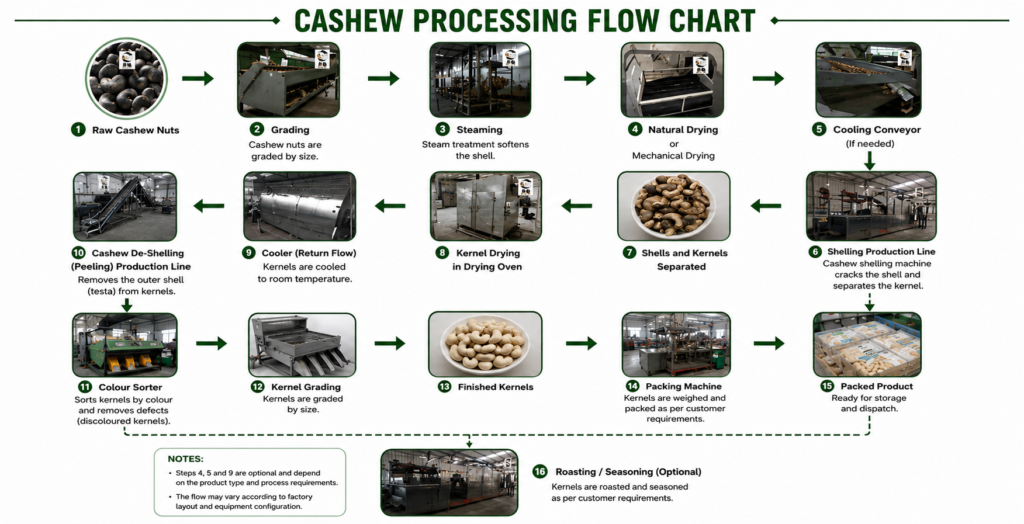
Why 90% vs 96% Is a Bigger Gap Than It Sounds
A shelling rate difference of six percentage points—90% versus 96%—may seem modest on paper. Across a processing season, it is anything but.
Consider a plant processing 500 tonnes of raw cashew nuts in a season. At a 90% shelling rate, 450 tonnes are successfully opened. At 96%, that figure rises to 480 tonnes—an additional 30 tonnes of opened nuts. With whole kernels trading at several thousand euros per tonne on export markets, the financial gap between the two machines is measured in tens of thousands of euros.
This is why processors in West Africa, where cashew production has expanded significantly in recent years, increasingly prioritise shelling rate as the single most important equipment specification during the purchasing process.
The Relationship Between Grading and Shelling Rate
A cashew nut sheller does not operate in isolation. Its performance is directly linked to the grading step that precedes it.
Raw cashew nuts vary considerably in size, even within a single batch. Feeding ungraded nuts into a sheller means the blade cannot be set to a single calibrated depth—it must either cut too shallow for larger nuts (leaving them unopened) or too deep for smaller ones (damaging the kernel). The result in both cases is a reduced shelling rate.
Industry best practice, as documented by equipment manufacturers and processing specialists, is to grade RCN into size bands before shelling. A typical grading range covers 18 mm to 26 mm in 2 mm increments. Once graded, each batch can be run through the sheller at an optimal blade setting, pushing the shelling rate towards that 96% benchmark.
Shelling Rate vs. Whole Kernel Rate: Understanding the Difference
These two terms are sometimes used interchangeably, but they measure different things:
- Shelling Rate: The percentage of nuts successfully opened by the sheller. A 96% shelling rate means 96 out of every 100 nuts are opened.
- Whole Kernel Rate: The percentage of opened nuts where the kernel remains intact, unbroken. This is a separate metric measured after shelling and shell-kernel separation.
A machine can have a high shelling rate but a low whole kernel rate if the blade is cutting too aggressively. The ideal sheller achieves both: a high shelling rate and a high whole kernel rate. When processors evaluate equipment, they should ask for both figures, not just the headline shelling number.
FAQ
Q: What is the difference between a cashew nut sheller and a cashew shelling machine?
A: The terms are largely interchangeable. A cashew nut sheller—sometimes called a cashew shelling machine or cashew deshelling machine—is the equipment that removes the hard outer shell from raw cashew nuts to release the kernel.
Q: What shelling rate should I expect from a modern sheller?
A: Well-calibrated automatic shellers should achieve a shelling rate of 90–95%, with the best machines reaching up to 96%. Semi-automatic and manual machines typically deliver lower rates due to operator-dependent consistency.
Q: Why is grading important for shelling rate?
A: Grading ensures uniform nut size entering the sheller, allowing the blade to be set to a single calibrated depth. This maximises the number of nuts successfully opened whilst minimising kernel damage.
Q: Can a sheller handle different cashew varieties?
A: Yes, but blade settings may need adjustment for different nut sizes and shell thicknesses. West African varieties, for example, may differ in dimensions from East African nuts. Confirm with the manufacturer that the machine can be calibrated for your specific RCN profile.
Summary: Key Facts About Cashew Nut Shellers
| Aspect | What to Know |
|---|---|
| Function | Removes the hard outer shell of raw cashew nuts to release the kernel |
| Shelling Rate | Modern automatic shellers achieve 90–96% shell opening rate |
| Working Principle | Graded nuts are carried by a rotating chain to a calibrated cutting blade |
| Key Success Factor | Grading nuts by size before shelling maximises shelling rate |
| Related Metric | Whole kernel rate measures intact kernels—equally important as shelling rate |
The cashew nut sheller sits at the centre of every cashew processing operation. Its performance—measured in that critical shelling rate percentage—ripples through every downstream stage, from kernel drying and peeling through to grading and export. A sheller that consistently delivers 96% is not just processing nuts. It is protecting margins, maximising whole kernel yield, and giving the processing plant its best chance of competing profitably in a demanding global market.